19 Reasons Why This Is An Excellent Resume
Recruiters spend an average of six seconds reviewing a resume before they make the initial decision on candidates, according to research conducted by TheLadders, an online job-matching service for professionals. That means you have to win them over fast.
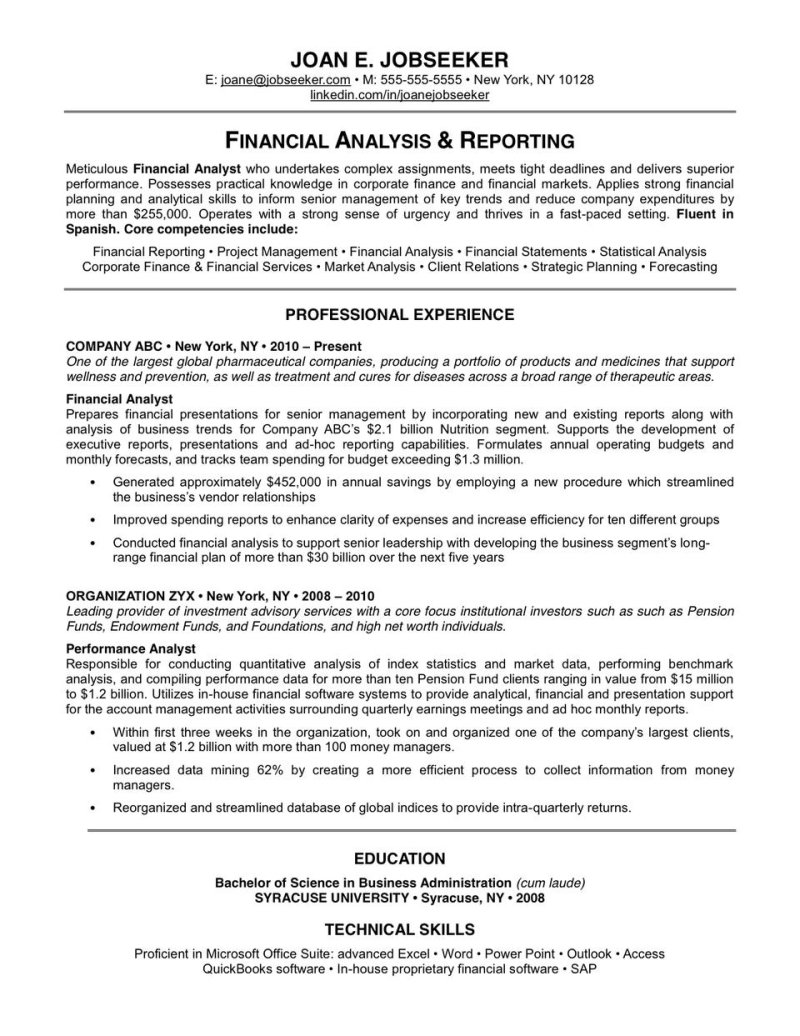
To get a better idea of what makes a resume great, we reached out to Amanda Augustine, career expert at TheLadders. She created an example of an excellent resume and allowed us to share it.
While resumes should be tailored
to the industry you're in, the one below offers a helpful guide for
entry- and mid-level professionals with three to five years of relevant
work experience.


TheLadders
What makes this resume so great? Augustine outlines the following reasons:
1. It includes a URL to the jobseeker's professional online profile.
If you don't include URLs to your
professional online profiles, hiring managers will look you up
regardless. Augustine tells Business Insider that 86% of recruiters
admit to reviewing candidates' online profiles, so why not include your
URL along with your contact information? This will prevent recruiters
from having to guess or mistaking you for someone else.
2. It uses consistent branding.
" If you have a common name, consider including your middle initial
on your resume and online professional profiles to differentiate
yourself from the competition," says Augustine. For example, decide if
you're Mike Johnson, Michael Johnson, or Mike E. Johnson. Then use this
name consistently, be it on LinkedIn, Google+, Twitter, or Facebook.3. It includes a single phone number and email address. "Choose one phone number for your resume where you control the voicemail message and who picks up the phone," she advises. The same rule applies to an email address.
4. It does not include an objective statement. There's no point in including a generic objective about a "professional looking for opportunities that will allow me to leverage my skills," says Augustine. It's not helpful and distracting. Ditch it.
|
Please enable Javascript to watch this video
WATCH: How To Make A Good First Impression At A Job Interview |
6. It uses reverse chronological order. This is the most helpful for recruiters because they're able to see what you've been doing in recent years immediately, says Augustine. "The only time you shouldn't do this is if you're trying to transition to another career altogether, but then again, in this situation, you'll probably be relying more on networks," than your resume, she says.
7. It uses keywords like "forecasting" and "strategic planning." Many companies use some kind of screening process to identify the right candidates. You should include the keywords mentioned in the job posting throughout your resume.
"Identify the common keywords, terminology, and key phrases that routinely pop up in the job descriptions of your target role and incorporate them into your resume (assuming you have those skills)," advises Augustine. "This will help you make it past the initial screenings and on to the recruiter or hiring manager."
8. It provides company descriptions.
It's helpful for recruiters to know the size of the company you used to work for, advises Augustine.
"Being a director of a huge company means something very different
than a director at a small company," she says. You can go to the
company's "About Us" section and rewrite one or two lines of the
description. This should be included right underneath the name of the
company.
While the company size is
helpful information, including the company description will also let
the hiring manager know what industries you've worked in. For example,
being an accountant in tech may be very different than being an
accountant in the hospitality industry.
"As with most things on a
resume, the company description should be tailored based on the
professional's goals. If you're looking to switch industries, your focus
may be on the company size — assuming it's similar to your goals — and
less on discussing the various products your company sells."
9. It does not list achievements in dense blocks of text.
Recruiters receive so many resumes to scan through at a time, so
make it as easy as possible for them to understand why you're perfect
for the job. Dense blocks of text are too difficult to read, says
Augustine.10. Instead, achievements are listed in two to five bullet points per job. Under each job or experience you've had, explain how you contributed to or supported your team’s projects and initiatives. "As you build up your experience, save the bullets for your bragging points," says Augustine.
11. It quantifies achievements. "Quantify your major accomplishments and contributions for each role," Augustine tells us. This can include the money you saved or brought in for your employer, deals closed, and projects delivered on time or under budget. Do not use any more than three to five bullet points.
12. Accomplishments are formatted as result-and-then-cause.
A good rule is to use the "result
BY action" sentence structure whenever possible. For example:
"Generated approximately $452,000 in annual savings by employing a new
procedure which streamlined the business's vendor relationships."
13. White space draws the reader's eyes to important points.
Recruiters do not spend a lot of
time scanning resumes, so avoid dense blocks of text. "The key is to
format the information in a way that makes it easy to scan and recognize
your job goals and relevant qualifications," Augustine tells us.
14. It doesn't use crazy fonts or colors.
"Stick to black and white
color," says Augustine. As for font, it's best to stick with the basics,
such as Arial, Tahoma, or Calibri.
15. It does not include pronouns.
Augustine says you should never
write your resume in third person because everyone knows you're the one
writing it (unless you go through a professional resume writing
service).
Instead, you should write it in
first person, and do not include pronouns. "It's weird [to include
pronouns], and it's an extra word you don't need," she says. "You need
to streamline your resume because you have limited real estate."
16. It does not include images.
"Avoid adding any embedded
tables, pictures, or other images in your resume, as this can confuse
the applicant-tracking software and jumble your resume in the system,"
says Augustine.
17. It doesn't use headers or footers.
It may look neat and concise to
display your contact information in the header, but for "t he same
reason with embedded tables and charts, it often gets scrambled in an
applicant tracking system," says Augustine.
18. Education is listed at the bottom.
Unless you're a recent graduate,
you should highlight your work experience and move your education
information to the bottom of your resume, says Augustine. Never include
anything about your high-school years.
19. It doesn't say "references upon request."
Every recruiter knows you're
going to provide references if they request it so there's no reason for
you to include this line. Again, remember that space on your resume is
crucial so don't waste it on a meaningless line, Augustine tells us.
Source:yahoo.com
 tripleclicks.com


No comments:
Post a Comment